Manitou Mastodon Comp Gen 3 Suspension 26" Fat Bike Fork
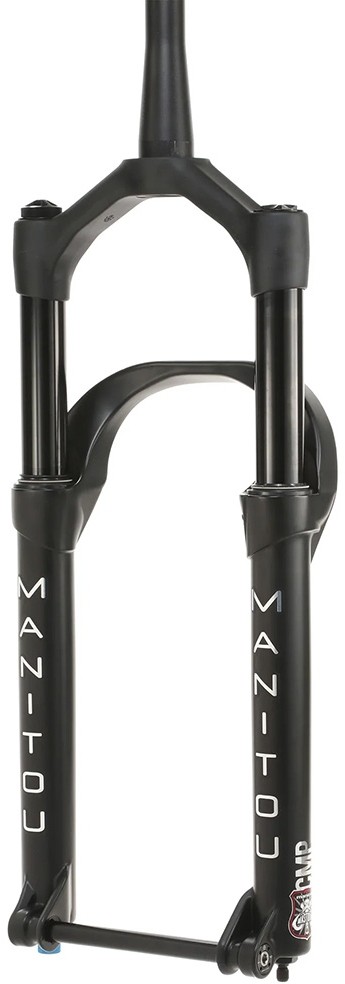
- 120g of weight savings from the previous model with a new crown, legs and internals.
- Expert Air allows for internal travel adjustments with no added parts. New travel spacers account for negative air volume change, so the 80mm fork has the same initial stroke feel as the 140mm.
- Expert Air spring systems contain a unique balancing valve that equalises the positive and negative air chambers during the air-fill process. This gives the spring rate a consistent feel without any flat or dead spots in the stroke, along with giving riders of different weights the same initial stroke feel. Expert Air has identical performance to DoradoTM Air in a more cost-effective package.
- Incremental Volume Adjust (IVA) modifies the volume in the positive air chamber with self-contained spacers dictating the position of the IVA piston. This allows the main air spring ramp-up to be tuned to the rider's weight, style and conditions without the need for additional parts.
- Absolute Plus (ABS+) is a shim stack-based damper that features external incremental Low-Speed compression adjustment.
- The new tune increases wheel traction, rider comfort and control.
- The new crown is 94g lighter, with increased knob clearance. 44mm offset to match modern fat bike geometry for precise handling and increased traction.
- Front brake routing allows the user to use the same length brake hose from their rigid fork, or other suspension fork. Updated casting with non-threaded compression rod holes for ease of service. New arch ribs for increased casting stiffness.
- Tyre diameter clearance is 2mm shorter than the current EXT model, with a 6mm reduction of axle to crown.
- Wheel Size: 26/27.5" Fat
- Offset: 44mm
- Axle To Crown: 80mm travel - 504mm, 100mm travel - 524mm, 120mm travel - 544mm, 140mm travel - 564mm
- Travel: 80-140mm internally adjustable in 10mm increments
- Spring: Expert Air w/ IVA
- Compression: ABS+
- Rebound Damping: in-leg adjustable TPC
- Adjustments: Air, Air Volume, Rebound, Compression
- Steerer: 1.5" Tapered
- Crown: Forged Aluminum, Hollow Bore
- Leg Diameter: 34mm
- Leg Material: 6000 - Series Straight Wall Aluminum
- Brake Post Mount: 180mm (203mm Max)
- Axle: 15mm x 150mm Hexlock SL
- Max Tyre: Size 26x5.05"/27.5x4.5"
- E-pac: Yes
- Weight: 2254g
Occasionally, without notice, manufacturers change product design and/or specifications.
Suspension Forks Sizing
A new suspension fork is one of the most noticeable and worthy upgrades you can make to your mountain bike. A higher quality fork will be able to deal with more difficult terrain, remaining composed on the trail and keeping your wheel in contact with the ground. This gives more grip, and therefore a more confidence inspiring ride.
Not all forks are made equal, there are some very important size and compatibility aspects to look at first.
Compatibility
Wheel size
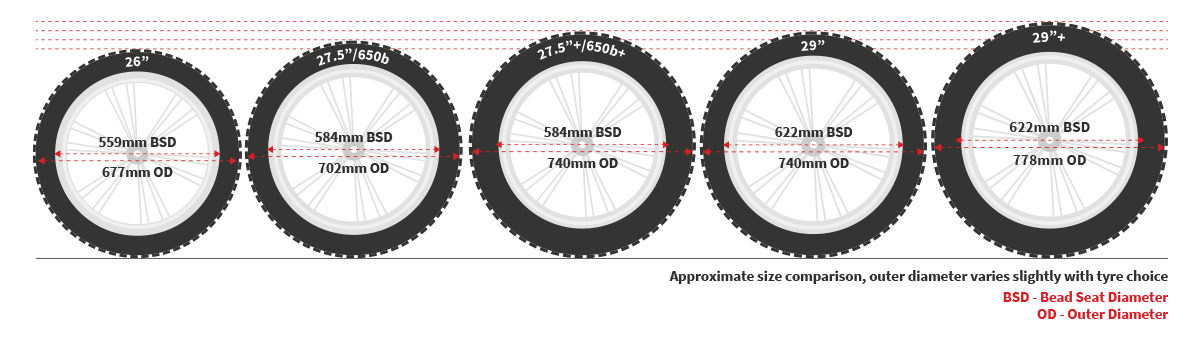
There are a few different wheel sizes for mountain bikes. 26”, 27.5” (650b) and 29” are the most common.
There is also plus (+) and fat versions available. If you are not sure it should be written on the side of the tyre.
Whatever wheel size you have, the fork must be designed to suit.
Fork steerer
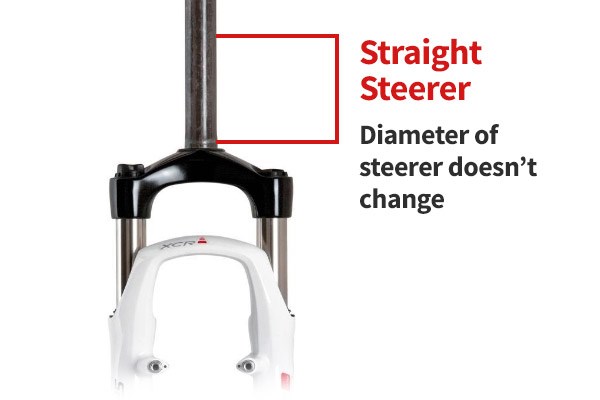
The fork steerer is attached to the fork crown, this comes up through the frame and headset to be clamped at the top by the stem.
Most modern bikes will have a tapered steerer, this is 1.5” inch wide at the fork and 1 1/8th inch at the stem. Some DH bikes and older mountain bikes will suit a straight 1 1/8th inch steerer.
It is easiest and best if the replacement fork has the same diameter steerer to fit into your frame and headset.
If you are unsure on the size, drop the forks out from the frame and you should be able to see straight away if the steerer is tapered or straight.

Axle size
If you are planning on using the same front wheel with your new fork, the fork’s dropouts must suit your wheel.
The width of the front hub has traditionally been 100mm, with either a 9 or 15mm axle. With a 9mm Quick Release (QR), a fork could be described as 9mm x100mm or QR to fit. A larger 15mm bolt through axle is more common on higher end bikes, a fork could be described as 15 x 100 to suit. This 15mm axle can be a quick release style and can be referred to as 15QR
Over the last few years, a wider 110mm spacing known as “Boost” has become the new standard, this is not available for 9mm QR axles and would be shown as 15mm x 110 or 15mm Boost.
20mm axles have been common on DH bikes for some time. Although DH wheels will be 110mm wide, they are not always “Boost”. There is a new DH Boost for front wheels and forks, this means the hub is still 110mm wide, but the disc rotor/mount sits 5mm out.
Travel
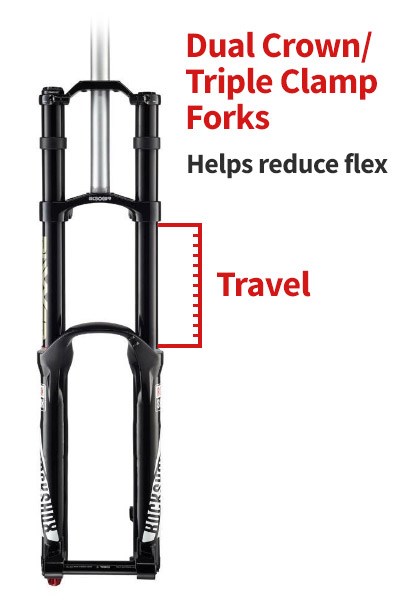
The amount of distance the fork can move vertically is referred to as travel (shown in mm). The frame manufacturer will have designed the bike around a certain amount of travel. The general rule is to stay with this. Increasing or decreasing the fork travel can result in the geometry being severely compromised, making the bike handle worse than intended and putting more stress on the headtube structure.
*Changing fork travel can void frame warranty from the manufacturer, please check with the manufacturer before any travel increase/decrease.
As fork travel increases so can flex, to combat this a triple clamp design is used for forks with over 180mm of travel. The hub plus the two crowns creates a triple clamp. The forks are for DH use.
Offset/Rake
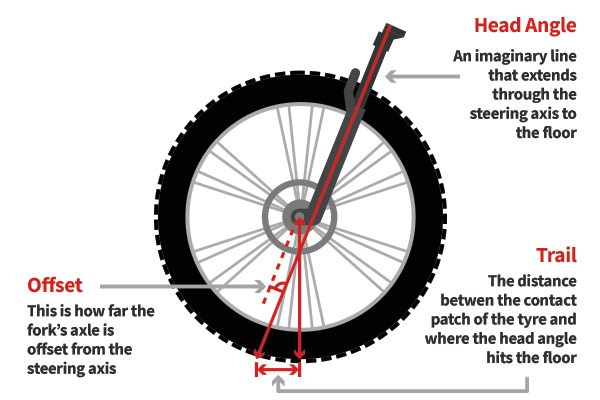
The distance the axle is offset from the steering axis. This directly affects the “Trail”. Trail is the distance between the contact point of the tyre and where the steering axis hits the floor. The shorter the offset the longer the trail and vice versa. Wheelsize also affects trail. Larger wheels have a longer trail. With the popularity of 29er MTB’s, there is often an offset choice to be made.
The most common offset for a 29er fork is 51mm, however, fork manufacturers offer shorter offsets to increase trail.
Fitting
Once the correct fork has been chosen there are a few things you should know before fitting.
Crown race – Slid down over the steerer is the crown race, these are usually particular to the headset on your bike. They create a seat for the lower bearings of the headset to sit on, this should be removed from your forks and slid into place on the new fork steerer before installing the new forks.
Star Nut – Inside the steerer tube there is a star nut. This has a wedge design allowing it to be slid down into place but not slid back up. There is an internal thread that takes the top cap bolt allowing the forks to be held in place and allowing adjustment of the pressure on the bearings.
Steerer length – A new fork will have a long uncut steerer, this will more than likely need to be cut to match the length of your original forks, however, it can be cut longer or shorter if you wanted to have more adjustment for stem height.
Setting Sag
See our full guide to setting sag here
Customer reviews and Q&A's are disabled because you declined functional cookies.
To enable reviews and Q&A's click the 'Cookie Settings' button below and enable functional cookies.
No longer available
Sorry you missed the Manitou Mastodon Comp Gen 3 Suspension 26" Fat Bike Fork.
This product is no longer available.